Master Logic and Business Flow Construction (Master)
Virtual product
{{ variable.name }}
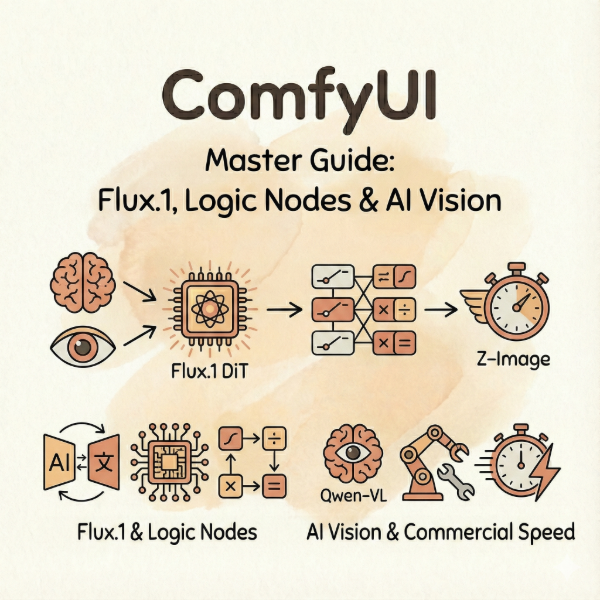
Master the cutting-edge of AI image generation with the latest models and professional workflow engineering. This master-level course covers Flux.1 (the next-generation model from Stable Diffusion's original creators), logic nodes for building intelligent switchable workflows, Qwen vision-language models for AI-powered image understanding, and the ultra-fast Z-Image model for commercial-grade speed.
Course Format: Digital e-book with interactive HTML courseware and ready-to-use workflow files (.json)
Course Highlights:
- Flux.1 deep dive: DiT architecture, dual text encoders (CLIP-L + T5-XXL), and why it draws perfect fingers and text
- Flux parameter mastery: CFG 1.0-3.5 settings, euler sampler, FP8/GGUF quantization for 8-12GB VRAM
- Logic nodes and switches: Build "all-in-one" workflows with rgthree Switch nodes and Fast Groups Muter
- Math Expression nodes: Dynamic parameter control for animations and resolution calculations
- Qwen2-VL integration: Give ComfyUI "eyes" and "brain" for reverse prompt engineering and image understanding
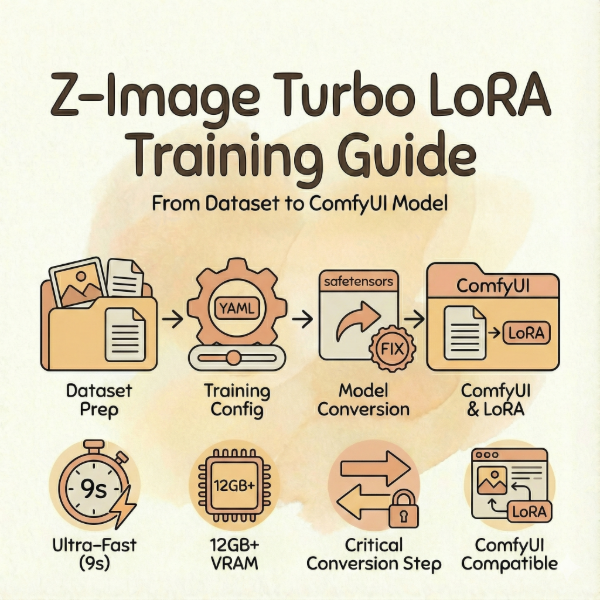
- Z-Image Turbo: Sub-second inference speed, 9-second image generation, photorealistic quality
What You'll Learn:
- Lesson 16: Flux.1 architecture, model variants (Pro/Dev/Schnell), workflow building, and LoRA/ControlNet compatibility
- Lesson 17: Logic nodes, Switch Any, Fast Groups Muter, and Math Expression for intelligent workflow design
- Lesson 18: Qwen2-VL setup with GGUF format for local AI vision and automatic prompt generation
- Lesson 19: Z-Image Turbo deployment for commercial-speed image generation
Technical Requirements:
- 8GB+ VRAM for Flux FP8 quantized models (12GB+ recommended)
- Required plugins: ComfyUI-GGUF, rgthree-comfy, ComfyUI-Custom-Scripts
Who This Course Is For:
- Professional AI artists ready for cutting-edge models
- Workflow engineers building commercial-grade automation systems
- Developers integrating AI vision models into image generation pipelines
- Power users seeking maximum speed and quality in production environments